
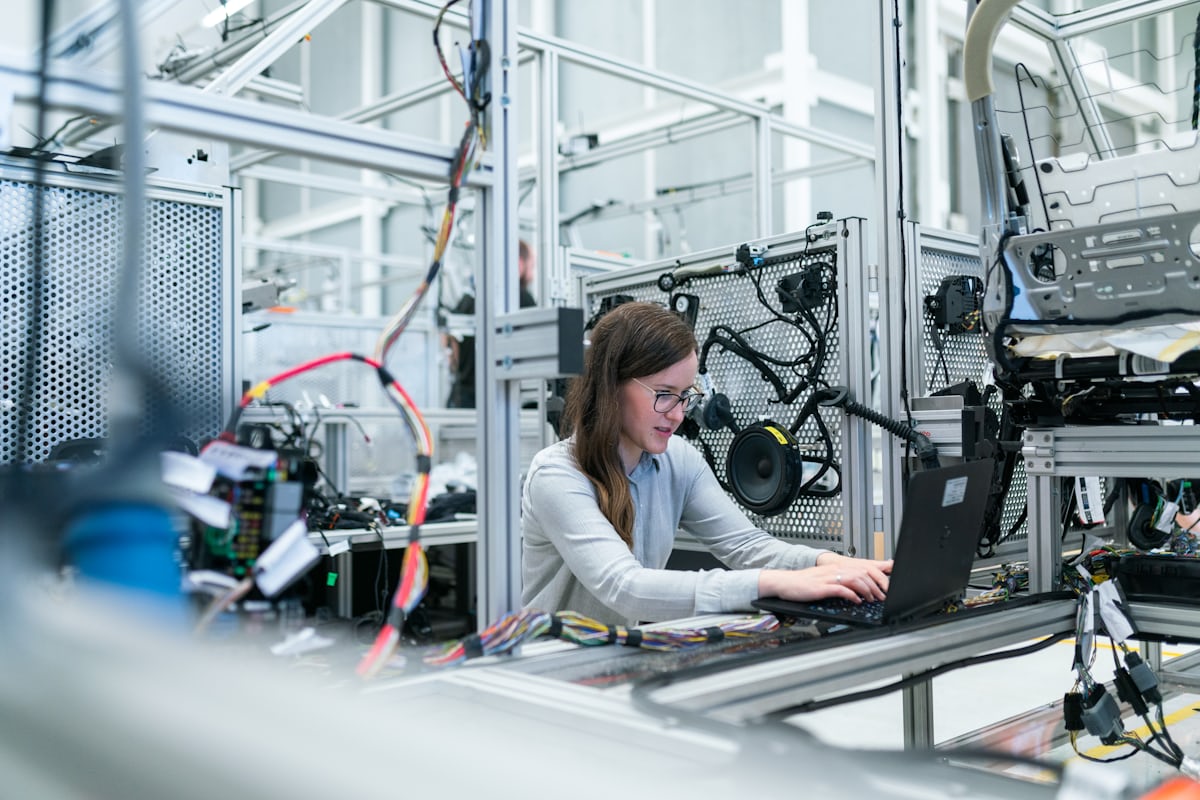
A ₹12 crore manufacturer still running on paper registers and WhatsApp forwards

The client — a Pune-based automotive parts manufacturer with 67 employees and approximately ₹12 crore annual revenue — had no digital operations system beyond basic accounting software. Purchase orders were written by hand. Production schedules were WhatsApp messages to floor supervisors. HR records were physical files. Monthly stock reconciliation required shutting down a warehouse section for a full working day.

The owner had looked at off-the-shelf ERP software twice in five years but found that generic systems required expensive customisation and disrupted workflows his team had used for a decade. He came to us wanting something built specifically for how his factory actually worked.

Four distinct problems compounding each other

Paper-based purchase and sales orders
Every purchase order and sales invoice was hand-written, then typed into Tally at month end. Errors were common, approval chains were unclear, and tracking order status required walking to the relevant desk.
Inventory discrepancies costing money
Monthly stock counts frequently revealed discrepancies of 8–15% between recorded and actual inventory — attributed to unlogged wastage, returns, and informal inter-department transfers.
No production tracking
Management had no real-time visibility of where an order was in the production process. Customer delivery estimates were guesswork, and late deliveries were causing relationship strain with two key automotive OEM clients.
HR and payroll manual process
Attendance was paper-based. Payroll was calculated manually in Excel every month — a 3-day process for the accounts manager that was error-prone and frequently required corrections after disbursement.

A structured 6-phase SEO programme

We built a phased plan that addressed technical foundations first, then content, then authority — in that order. Skipping the technical audit would have wasted the content investment.

1
On-site discovery and process mapping
Three weeks embedded with the client team across all departments. Produced 47 process flow diagrams and a complete data model. Every module was reviewed with its end user before development began.
3-week on-site discovery47 process diagramsDepartment interviewsUser-reviewed data model
2
Inventory and warehouse module
Real-time stock tracking with barcode scanning at goods receipt, production consumption, and dispatch. Inter-department transfer logging. Wastage recording. Automated low-stock alerts to purchase manager. Stock accuracy went from ~87% to 98%.
Barcode scanningReal-time stock levelsWastage trackingLow-stock alerts
3
Purchase and sales order management
Digital PO workflow with multi-level approval (floor manager → purchase manager → director). Supplier portal for order acknowledgement. Sales order tracking with production status linked. Customer-facing order status page via unique link.
Digital PO workflowMulti-level approvalsSupplier portalCustomer status page
4
Production scheduling and tracking
Production orders linked to sales orders. Floor supervisors update stage completion via tablet interface. Management dashboard shows live status of every active production order. Delivery date estimator based on current queue.
Production order linkingTablet interfaceLive dashboardDelivery estimator
5
HR and payroll module
Biometric attendance integration replacing paper registers. Leave management with approval workflow. Monthly payroll auto-calculated from attendance data with statutory deductions (PF, ESI, PT). Payslips generated as PDF and sent via WhatsApp.
Biometric integrationLeave managementAuto payroll calculationWhatsApp payslips
6
Reporting and director dashboard
Single director dashboard showing: revenue vs target, production throughput, pending POs, inventory value, top customers by revenue, and HR headcount. 22 operational reports available on demand, all exportable.
Director dashboard22 operational reportsRevenue vs targetExport to Excel/PDF

How progress unfolded

Month 1 — June
Discovery and architecture
On-site process mapping completed. 47 flow diagrams produced and signed off. Data model finalised. Development environment set up. Client team identified as system champions per department.
Month 2 — July
Inventory and purchase modules
Inventory module with barcode scanning live in staging. Purchase order workflow built and tested with purchase manager. Supplier portal deployed. First real data loaded.
Month 3 — August
Sales, production, and HR
Sales order and production tracking modules built. Tablet interface deployed on factory floor. Biometric attendance integration completed. HR module in UAT with accounts manager.
Month 4 — September
Payroll, reporting, and integration
Payroll engine built and tested against 6 months of historical data — matched to within 0.3% of manual calculations. 22 reports built. Director dashboard assembled.
Month 5 — October/November
Parallel run and go-live
4-week parallel run with old system alongside new. All 67 staff trained in their relevant modules. Go-live on 1 November. Old paper system officially retired.

The numbers speak clearly

Before (June 2024)
Stock reconciliation timeFull working day monthly
Inventory accuracy~87%
Order processing timeBaseline
Payroll preparation time3 days/month
Paper documents per week~340 sheets
Production visibilityNone (WhatsApp)
Late deliveries to OEM clients~18% of orders
After (November 2024)
Stock reconciliation time20 minutes — automated
Inventory accuracy98%
Order processing time−65%
Payroll preparation time4 hours/month
Paper documents per week~68 sheets (−80%)
Production visibilityLive dashboard
Late deliveries to OEM clients~4% of orders
80%
Reduction in paper documents per week
98%
Inventory accuracy — up from 87%
−65%
Order processing time
The accounts manager's monthly payroll process dropped from 3 full days to 4 hours — she described it as 'the single biggest improvement in my working life in 11 years here'
Late deliveries to the two key OEM clients dropped from 18% to 4% of orders within 2 months of go-live, materially improving the commercial relationship
The owner discovered through the new reporting that one product category had a 34% higher margin than believed — previously invisible because cost data lived in separate paper records
The client has since hired two additional production staff using the headcount freed from administrative tasks — their first non-operational hires in four years
"

We showed 10 different ERP companies our requirements and every one of them told us to change our processes to fit their software. These people changed their software to fit our processes. That's the difference. After 5 months of using it, I can tell you exactly how much stock we have, where every order is, and what our revenue looks like — in real time, on my phone. That never existed before.

VP
★★★★★
Vivek Patil
Managing Director, Automotive Parts Manufacturer — Pune, India (name withheld by request)